
Organizational Relationship Intelligence – What is it all about?
Organizations know a lot about their finances, customers, processes and employees.
We measure revenue, productivity, customer satisfaction, engagement, absenteeism and countless other indicators. We map customer journeys, analyze every interaction with our customers and invest heavily in understanding what makes them stay, buy and recommend us.
But ask a seemingly simple question:
How well do you understand the relationships between the people in your organization?
Are people part of the group, or are some left outside? Do people from different parts of your organization connect, or are they stuck in silos? How dependent are your informal information flows on a few people? And perhaps even more importantly, do people have genuine personal relationships across the organization, or are their relationships strictly formal?
For most organizations, those questions are considerably harder to answer. That’s a problem, because much of what an organization achieves happens between people. And that’s where Organizational Relationship Intelligence comes in.
What is Organizational Relationship Intelligence?
Organizational Relationship Intelligence, ORI, is the capability to systematically strengthen, understand and measure the relationships within an organization, and use that knowledge to improve collaboration, psychological safety and organizational performance.
There are several important parts to that definition.
ORI is not simply about measuring relationships. It is not another employee survey or HR dashboard, and it is not just Organizational Network Analysis with a different name.
ORI is about developing an organizational capability around relationships: to strengthen them, understand them, measure what is happening and then use that knowledge to decide what to do next.
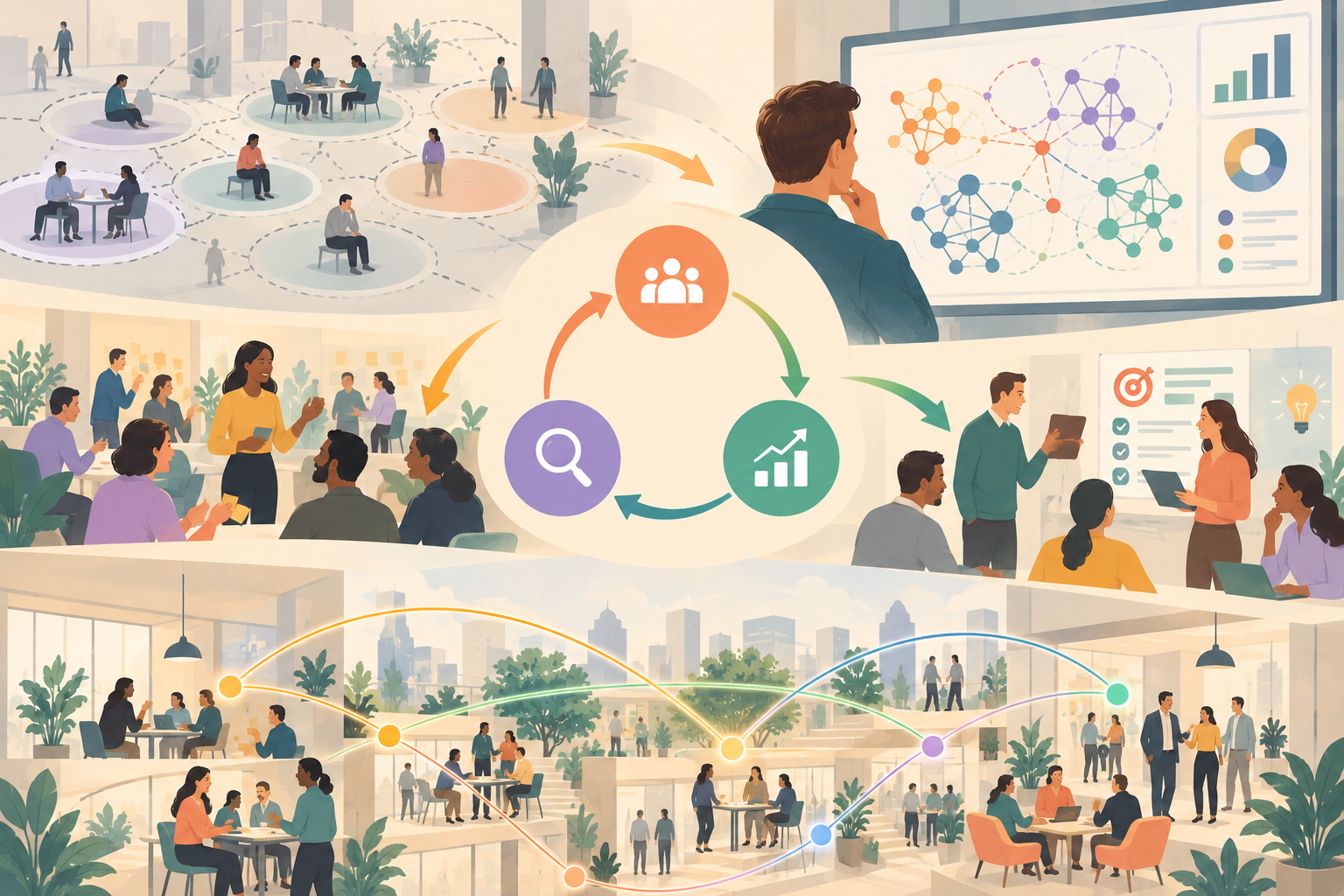
Simple as it sounds, it’s a loop:
Activity → Analysis → Action → repeat
Over time, there is another important dimension to that loop. By connecting what we learn about relationships with the operational and financial data the organization already collects, we can also start learning which relationship patterns are associated with better or worse outcomes.
All three parts matter.
Why focus on relationships?
We often talk about organizations as if they consist primarily of individuals. We measure whether I am engaged, to what extent I feel psychologically safe, whether I am satisfied with my manager and whether I intend to stay. All of that is useful information.
But collaboration does not exist inside one individual. Neither does trust. A relationship always has at least two ends.
If I feel comfortable challenging your ideas but you are afraid of challenging mine, what exactly is the level of psychological safety in our relationship?
If ten people all say that they enjoy working in their team, we have ten useful data points. But we still do not know how those ten people are connected. We might have two subgroups barely interacting with each other.
This is one reason why I think we sometimes simplify discussions about culture and group dynamics too much.
A group can enjoy spending time together and still struggle to challenge each other. A team can score well in an engagement survey while being highly dependent on one central person. And an organization can have a perfectly logical organizational chart while the actual flow of relationships follows completely different paths.
Think of the organizational chart as the official map of a park. It shows where somebody intended the paths to be. Relationships are the tracks people have actually made across the grass. If you want to understand how people really move in the park, you need both.
Strengthening relationships comes first
This is one of the differences between ORI and many traditional approaches to organizational analysis. The starting point is not necessarily to define what to measure, followed by planning, data collection, analysis, prioritization and activity definition.
Sometimes the first question should be as simple as:
What can we do to improve the relationships?
If we look at what’s on the market, organizations already invest considerable resources in leadership development, workshops, team activities, culture initiatives and employee engagement. There is nothing wrong with that.
The problem is that these activities are often disconnected from both measurement and what happens afterwards. We run the workshop, conduct the survey or analyze some HR data. Then, a few months later, we try to determine whether the organization has somehow improved.
ORI starts with strengthening, and then moves on to connecting these pieces.
The initial activity of ORI should be deliberately designed to strengthen relationships while also creating new insight into how those relationships work. That insight can then determine the next interventions. Those interventions do not have to be the same for everyone; the organization can increasingly direct its efforts to where they are actually needed.
Perhaps two departments need stronger connections. A team may need to reduce its dependency on one central person. Or a group of employees may be too peripheral to the wider organization.
Different relationship structures require different actions.
Understanding the organization between the boxes
This brings us to analysis. Organizations normally have an excellent understanding of their formal structures. We know who reports to whom, which people belong to Finance, Sales, Operations or Development, which office they work in and often which projects they are assigned to.
But formal structure and actual relationships are not the same thing. Two teams may belong to the same department but hardly interact, while people in completely different parts of the organization may have strong relationships that make collaboration possible.
A manager may formally connect two departments while almost no relationships exist between the people in those departments. And the person who appears to be a fantastic connector may also represent a major organizational dependency. What happens when that person changes role, becomes overloaded or leaves?
This is where approaches such as Organizational Network Analysis can provide valuable insight. ONA can help us understand who is connected to whom, identify clusters, detect silos and see which individuals bridge different parts of an organization.
But that is only part of Organizational Relationship Intelligence.
Organizational Relationship Intelligence is broader than Organizational Network Analysis
The easiest way to understand the distinction is that ORI covers what happens both before and after ONA.
Before, because relationships should not only be observed. They can be deliberately strengthened.
After, because knowing what the network looks like has limited value unless that knowledge changes what you do.
A network map does not change an organization. It’s a decision-making tool.
Imagine discovering that almost all communication between two parts of your organization passes through three managers. Interesting. But what now?
Perhaps that structure works perfectly well, or perhaps it means that collaboration between the two groups is unnecessarily dependent on their managers. The map cannot make that decision for you.
Similarly, finding a person at the edge of a network should not automatically lead to the conclusion that the person is disengaged or about to leave. Perhaps they are. Or perhaps the organization is failing to make use of someone who could contribute much more if the right relationships existed.
Analysis should help us ask better questions and act on what we learn. That is why ORI is not just about understanding the network. It is about building an organizational capability to continuously strengthen it.
From generic initiatives to targeted action
This also changes how we can think about organizational development.
Many organizations work with culture and collaboration through broad interventions. Everybody attends the same workshop and receives the same leadership initiative, and every team discusses the same survey questions. Sometimes that is exactly what is needed.
But imagine that we knew more about the actual relationship structure.
We might discover that collaboration inside each team is strong, while relationships between teams are weak. The appropriate action is then probably not another team-building exercise inside the teams.
What if one individual connects almost everybody else? The challenge is not necessarily to strengthen that person’s relationships even further. It may be more important to build alternative connections around them.
Or we might identify a group that has become increasingly isolated from the rest of the organization. Again, that suggests a different intervention.
The more we understand about the relationships, the more precisely we can act. And after acting, we can learn again.
Activity → Analysis → Action → repeat.
This is not about creating another KPI
Whenever we start measuring something new in organizations, there is a temptation to reduce it to another number. I do not think that should be the goal of ORI.
That does not mean that relational indicators are unimportant. Quite the opposite.
We can measure things such as levels of psychological safety and insecurity, how centralized a network is around a few individuals, how fragmented it is into separate clusters, how strong the relationships are between organizational groups and how many people are isolated or belong to small islands with weak connections to the rest of the organization.
Each of those measures can tell us something useful.
But the real value does not come from adding another set of green, yellow and red indicators to the management dashboard. It comes from combining them with each other, following how they change and, increasingly, relating them to what the organization is actually trying to achieve.
Consider two teams. Team A delivers five new services per 1,000 working hours. Team B delivers ten using 800. We know that Team B has produced more with fewer hours. But why?
Better processes? Higher competence? Different incentives? Better leadership? Perhaps.
But there is another possibility. Maybe the relationships work differently. Are people comfortable asking for help? Do they dare to challenge a bad idea before the team spends three weeks developing it? How quickly can somebody build on a colleague’s idea? Does knowledge move through the whole team or become stuck with a few individuals?
Traditional performance metrics tell us what happened. Relational indicators can help us understand more about what happened between the people while they were achieving it. The next step is to connect the two.
Connecting relationship data to organizational performance
This is an important part of where I believe Organizational Relationship Intelligence needs to go.
Most organizations already have huge amounts of operational and financial data. Productivity, quality, absence, employee turnover, lead times, customer satisfaction, project performance, sales, profitability and many other measures are already being followed. At the same time, ORI gives us another layer of information: data about how people are connected and how those relationships appear to function.
The interesting question is what happens when we start putting those two layers together.
- Is stronger psychological safety associated with lower absence, higher productivity or fewer quality problems?
- Does high centralization around a few people correlate with high short-term performance, but also with increased dependency or vulnerability?
- Are teams with stronger cross-group relationships better at innovation, knowledge sharing or delivering complex projects?
Those are much more interesting questions than simply asking whether a network score went up or down. And they can increasingly be answered with data.
ORI can help an organization build its own evidence over time. And with the right support, the evidence can be accelerated by comparing it with industry and geographical benchmarks. Of course, this requires careful data selection; the relationships that matter in a software company may not be the same as those that matter in a hospital, a factory or a government agency.
We can measure relationship indicators in different geographies, companies, teams, departments or business units and compare them with existing operational and financial KPIs. We can follow both over time. We can look for repeated patterns and correlations and use those patterns to formulate better hypotheses about what may be influencing performance.
That is how ORI can gradually move organizational development from generic assumptions towards an evidence base built on the organization’s own reality.
For the first time, we can actually get a good indicator of what financial outcomes the CEO can expect if he only lets the Chief People Officer work with the interventions.
Relationships don’t appear in the P&L. Their effects do.
This is also where Organizational Relationship Intelligence becomes economically interesting.
It is easy to talk about relationships, group dynamics and psychological safety as “soft” issues. But what happens if we follow the chain all the way?
If people have relationships that allow them to trust each other, ask for help, share information and challenge a bad idea, it should affect how well they can work together. If they work better together, we should eventually expect some of that difference to become visible in the outcomes of the organization.
The relationship itself will never appear as a line in the P&L.
Absenteeism will. Employee turnover will. Productivity will. Quality problems will. Lost sales, delayed projects and operational inefficiencies will. And eventually those things affect profitability, cost or, in a public organization, how much value can be delivered with the available resources.
There is good reason to be cautious about claiming direct causality here. Gallup’s large Q12 meta-analysis did not measure the quality of organizational relationships. It measured employee engagement and compared it with business outcomes. But the results show why the chain is worth understanding.
The study included 736 studies from 347 organizations, covering 183,806 business and work units and more than 3.35 million employees across 90 countries. Comparing business units in the highest and lowest quartiles of employee engagement, Gallup found median differences including 23% in profitability, 14% in productivity based on production records and evaluations, 18% in sales productivity, 78% in absenteeism and 21% to 51% in employee turnover depending on the underlying turnover rate.
Those are not small differences.
But they do not mean that better relationships automatically create 23% higher profitability. Gallup measured engagement, not relationships, and an association between engagement and performance is not the same thing as proving that one specific factor causes the other.
What the findings demonstrate is something more fundamental: what happens to people inside an organization is connected to hard organizational outcomes.
Engagement does not emerge in a vacuum. How I function at work is affected by the people around me. Can I rely on my colleagues? Do I get help when I need it? Are my ideas heard? Can we challenge each other? Do I feel that I am actually part of the group?
This gives us a chain that organizations need to understand much better:
Relationships → how people work together → operational outcomes → organizational and financial results
The ambition of ORI is to make more of that chain visible.
If we can relate measures of psychological safety, centralization, fragmentation, isolation and cross-group relationships to productivity, absence, turnover, quality, profitability or whatever outcomes matter in a particular organization, we can start building an evidence base for the economic relevance of relationships.
Not a generic promise that “better relationships increase profits by X percent”, but something much more useful:
An understanding of which relational factors are associated with which outcomes in this organization.
That distinction matters. It moves the discussion away from trying to assign an arbitrary monetary value to “good relationships” and towards understanding the mechanisms through which the organization’s own relationships may support or constrain performance.
Why now?
The need to understand organizational relationships is not new. But I believe it is becoming more important.
Organizations are increasingly distributed across functions, geographies, companies and digital environments. At the same time, technology and AI are rapidly changing what work is performed by humans and what can be automated.
As more knowledge and technical capability become readily available, the human ability to collaborate, challenge ideas, combine perspectives and build on each other’s knowledge becomes increasingly significant. That ability does not emerge from an organizational chart. It emerges through relationships.
Yet those relationships are still something many organizations largely leave to chance.
We would never run a serious sales organization without trying to understand our relationships with customers. We would not manage a supply chain without understanding its dependencies. And we do not manage finances by looking at the bank balance once a year.
So why should the relationships between the people who are expected to collaborate every day remain almost invisible?
Building Organizational Relationship Intelligence
ORI is ultimately a shift in perspective: from looking primarily at the people in an organization to also looking at what exists between them. From isolated activities and isolated measurements to a continuous process. From simply observing relationships to deliberately strengthening them. And from analysis for the sake of analysis to knowledge that leads to action.
But there is one more shift. From treating relationships and business performance as two separate discussions to systematically investigating how they are connected.
That is why my definition of Organizational Relationship Intelligence contains all three parts:
The capability to systematically strengthen, understand and measure the relationships within an organization, and use that knowledge to improve collaboration, psychological safety and organizational performance.
Not because relationships are the only thing that determines organizational performance. They are not.
But because they are one of the fundamental parts of how people turn individual knowledge, experience and effort into something they can achieve together. And if we can understand the connections between relationship structures, how people work together and the results they produce, we can start treating relationships as something that can be actively managed, developed and evaluated rather than simply hoped for.
Compared with almost everything else we manage in an organization, we still know surprisingly little about them.
It is time to change that.